Sublustris: Latin, “dimly lit, faintly glowing”, the half-light of a clouded night.
A big, dark reverb for ambient and dub techno. Turn the decay up and a chord holds forever while you play over it. Then let it age, from warm tape saturation to a thin, crackly radio, wavering like a cassette on a tired deck.
For the Noise Engineering Versio, and as an AU/VST3 plugin for macOS.
What it sounds like
The endless pad
One pad chord held into an endless tail, then nothing more is played.
Transcript: A soft synth pad plays one A minor chord, with an added ninth, and holds it for about eight seconds. The reverb swells in under the chord and never lets go. When the chord is released nothing more is played, and the wash goes on at a steady level, still holding the chord's notes, until the clip fades.
0:00 / 0:24
Settings for The endless pad
Settings for The endless pad
SPACE
CANYON
ONSET
NATURAL
BLEND
03:000.8the fader's start
DECAY
05:001
TONE
11:000.4
WEAR
07:000
SIZE
02:000.7
MOTION
12:000.5
DEPTH
09:000.2
Pad synthesised in code.
Freeze, then paint
A piano chord is frozen into a still pad, a piano melody plays over it, and its last phrase is painted in.
Transcript: A grand piano plays one D minor ninth chord. A moment later the button is tapped, and the hall freezes the chord into a still pad that holds its level instead of fading. The piano plays a slow melody in three phrases over the pad, and the pad doesn't take them in. During the last phrase the button is held, and the melody's long high A is painted into the pad: from then on the pad carries that note too. A last tap lets the pad go, and it fades away.
0:00 / 0:28
Settings for Freeze, then paint
Settings for Freeze, then paint
SPACE
HALL
ONSET
NATURAL
BLEND
01:000.6the fader's start
DECAY
02:300.75
TONE
12:000.5
WEAR
08:000.1
SIZE
12:000.5
MOTION
12:000.5
DEPTH
09:000.2
FREEZE / PAINT
tap at 1.6 s (freeze), held 15.4-20.6 s (paint), tap at 22.5 s (release)
Piano: Steinway B from the Versilian Community Sample Library (CC0). Played in code.
Dub techno stabs
Minor-ninth stabs on the send over a kick and rimshot, in a short, small hall that sits behind the groove.
Transcript: A dub techno groove at 118 bpm: a kick on every beat, a rimshot, a quiet hat, and short C minor ninth chord stabs on the offbeats. Only the stabs go into the reverb, a short, small hall: each stab leaves a soft, warm echo of itself that fades in about a bar, behind the drums, the way a reverb send sits in a mix. After eight bars the groove stops and the last tail dies away.
0:00 / 0:21
Settings for Dub techno stabs
Settings for Dub techno stabs
SPACE
HALL
ONSET
NATURAL
BLEND
10:300.35the fader's start
DECAY
10:300.35
TONE
11:300.45
WEAR
09:000.2
SIZE
10:000.3
MOTION
11:000.4
DEPTH
10:000.3
Drums: Virtuosity Drums by Versilian Studios and Karoryfer (CC0). Stabs synthesised in code.
Bloom swell
Single piano notes, each one swelling in slowly behind itself.
Transcript: A grand piano plays six soft single notes in A minor, about four seconds apart. Each note is dry and close; its reverb starts almost silent and swells in over the next two or three seconds, so every note blooms in behind itself and joins a long, soft wash.
0:00 / 0:27
Settings for Bloom swell
Settings for Bloom swell
SPACE
CANYON
ONSET
BLOOM
BLEND
01:000.6the fader's start
DECAY
02:000.7
TONE
11:300.45
WEAR
07:000
SIZE
12:000.5
MOTION
12:000.5
DEPTH
02:000.7
Piano: Steinway B from the Versilian Community Sample Library (CC0). Played in code.
Shimmer melody
A slow lead with one steady octave above it in the reverb.
Transcript: A soft, round synth lead plays a slow melody in D minor, with long notes and space between the phrases. The reverb adds one steady octave above each note: a quiet, higher voice that follows the melody and rings on in the tail. The lead has no octave of its own; the octave is only in the reverb.
0:00 / 0:27
Settings for Shimmer melody
Settings for Shimmer melody
SPACE
HALL
ONSET
SHIMMER
BLEND
01:000.6the fader's start
DECAY
03:000.8
TONE
12:000.5
WEAR
07:000
SIZE
02:000.7
MOTION
12:000.5
DEPTH
12:000.5
Lead synthesised in code.
Worn guitar
Slow guitar chords while WEAR is turned up from fully left to 2 o'clock: hiss and grain come into the tail.
Transcript: A clean electric guitar strums seven slow chords in E minor, one every few seconds, while WEAR is turned up steadily from fully left. At the start the reverb is clean. As WEAR comes up, a soft hiss and grain rise into the top of the tail, and its deepest lows thin a little.
0:00 / 0:28
Settings for Worn guitar
Settings for Worn guitar
SPACE
HALL
ONSET
NATURAL
BLEND
12:000.5the fader's start
DECAY
01:000.6
TONE
10:000.3
WEAR
fully left → 2 o'clock, turned steadily from 1 to 24 s
SIZE
11:000.4
MOTION
12:000.5
DEPTH
09:000.2
Guitar: Emilyguitar by Karoryfer (CC0). Played in code.
The tape side of MOTION
Held poly synth chords with MOTION fully left, the tape side: wow, flutter, crinkle and short dropouts every few seconds.
Transcript: A warm analogue-style poly synth, saw waves through a resonant low-pass filter, plays held chords, D minor nine, G minor seven, C nine and F major seven, with a few single notes between, twice through; the last chord rings on. With MOTION fully left the whole tail wavers in pitch together, like a worn tape, with quick crinkles, and every few seconds a short dropout dips it and dulls it for a moment.
0:00 / 0:28
Settings for The tape side of MOTION
Settings for The tape side of MOTION
SPACE
HALL
ONSET
NATURAL
BLEND
01:000.6the fader's start
DECAY
02:000.7
TONE
11:000.4
WEAR
09:000.2
SIZE
12:000.5
MOTION
07:000
DEPTH
09:000.2
Synth synthesised in code.
The radio side of MOTION
Picked guitar chords while MOTION is turned from noon to fully right: the tail narrows into an old radio and starts to phase.
Transcript: A clean electric guitar picks seven chords in D major, one every few seconds, each left to ring into a long hall. MOTION starts at noon, and the tail is full and open. As it turns right, the tail narrows, losing its deepest lows and its top, like the reverb is playing through an old AM radio, and a slow notch drifts through its middle so it swirls like a phaser. From about 16 seconds MOTION is fully right and the swirl is deepest.
0:00 / 0:28
Settings for The radio side of MOTION
Settings for The radio side of MOTION
SPACE
HALL
ONSET
NATURAL
BLEND
01:000.6the fader's start
DECAY
02:300.75
TONE
12:000.5
WEAR
07:000
SIZE
01:000.6
MOTION
noon → fully right, turned steadily from 2 to 16 s, then held
DEPTH
09:000.2
Guitar: Emilyguitar by Karoryfer (CC0). Played in code.
Dark drone, WEAR's whole range
A low drone into an endless tail while WEAR is turned all the way up and back down: the wash ages, then comes clean.
Transcript: A low, dark drone in D minor swells in and holds, then fades out at about 24 seconds; the reverb is endless, so the wash goes on. WEAR starts fully left, and the tail is clean and smooth. Over twelve seconds it is turned all the way up, and the wash ages as it goes: a warm tape thickness and a soft breath first, then grit and grain over the top as it nears fully right. The lows stay where they are. It holds there for a few seconds, then WEAR is turned back down and the wash comes clean again.
0:00 / 0:28
Settings for Dark drone, WEAR's whole range
Settings for Dark drone, WEAR's whole range
SPACE
CANYON
ONSET
NATURAL
BLEND
04:000.9the fader's start
DECAY
04:300.95
TONE
10:000.3
WEAR
fully left → fully right (2-14 s), held to 18 s, then back to fully left by 25 s
SIZE
12:000.5
MOTION
10:000.3
DEPTH
11:000.4
Drone synthesised in code.
Dry
Wet
Get it
Firmware for your Versio, and the same sound as an AU/VST3 plugin for macOS.
Infinite reverb began as a trick with two tape machines.
In 1972 Robert Fripp spent an evening with Brian Eno, who “had a system of recording with two Revoxes.” The tape ran from the first machine to the second, and the second machine’s playback fed back into the first one’s record head. Each sound came round again a few seconds later, a little quieter each time. Fripp played into it, and the result became (No Pussyfooting). By 1977 his version had a name: Frippertronics. In 1975 Eno released Discreet Music and printed a diagram of his echo setup on the back cover.
A reverb works the same way inside. Each trip round its loop loses a little level, and that loss is the decay. Set the loop to lose nothing and the tail goes on forever. By 1986 Lexicon’s PCM70, which used David Griesinger’s reverb from the Lexicon 224, had a program called Infinite Reverb. One reviewer held the reverb of a single note, then added a second to build a chord.
Pedals brought it to the floor. The Electro-Harmonix Freeze (2010) holds any note or chord while you press its footswitch. Reverbs now often offer two versions: infinite keeps taking in what you play, and freeze holds what’s there and lets nothing new in.
Sublustris has both. Past about 3 o’clock, DECAY makes the tail endless. It follows your playing at the level of the longest tail, and when you stop it holds, its notes still in PLATE and HALL. FREEZE holds the tail as a still pad you play over. Hold the button while frozen and it paints a little of what you play into the pad.
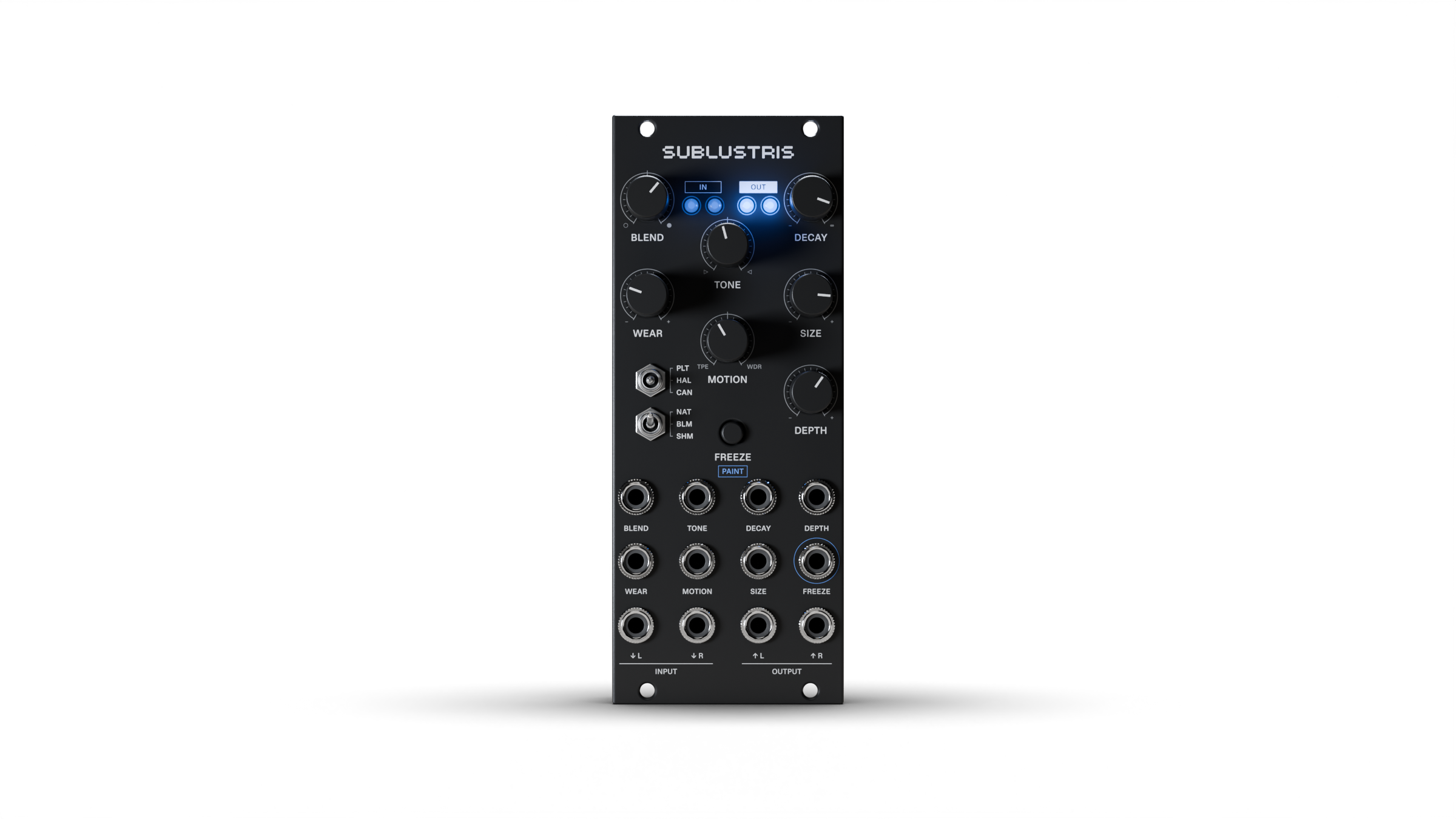
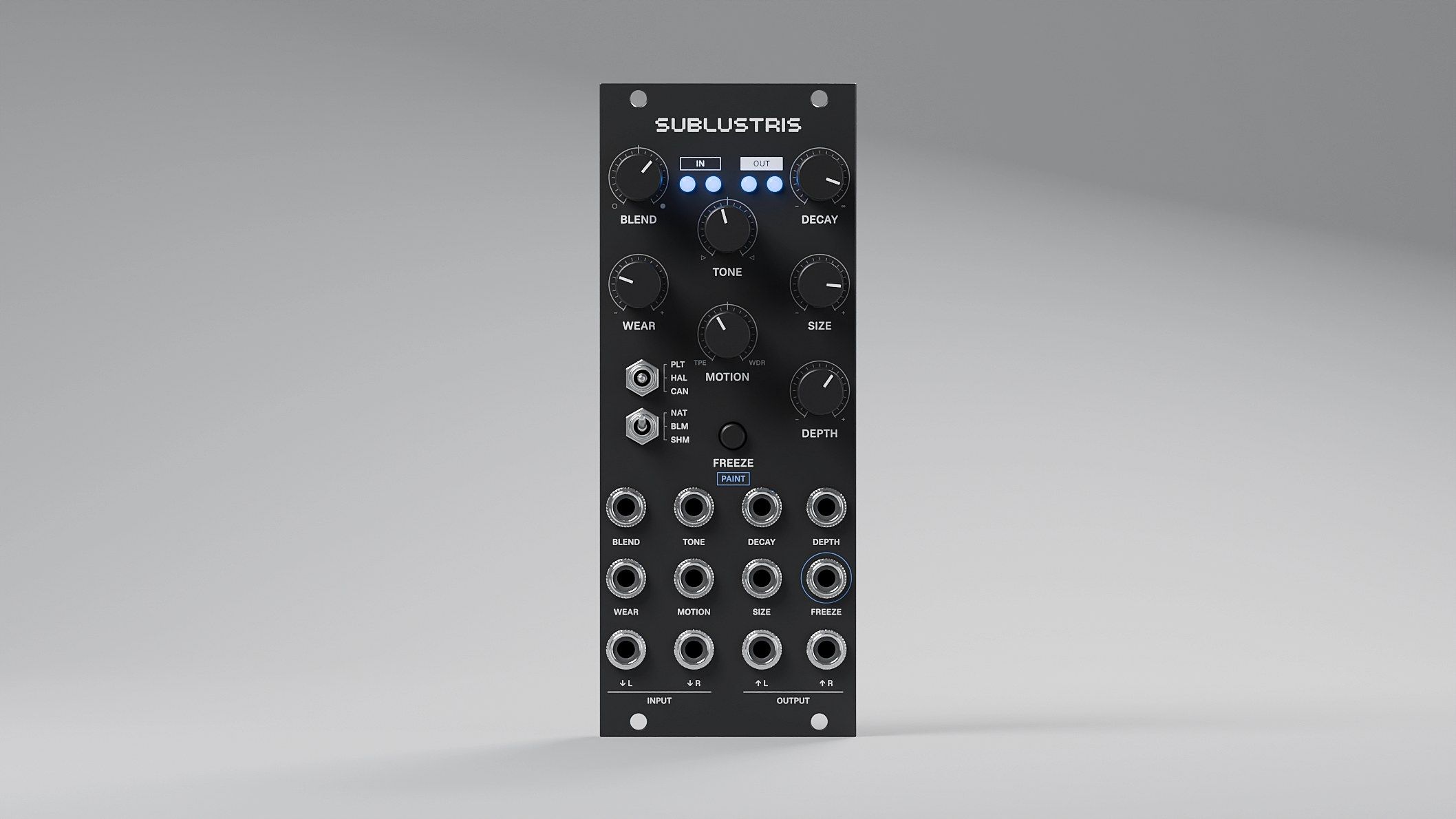
The panel
Sublustris runs behind your Versio’s printed panel, so the labels on your module won’t match. Here’s what’s where.
123456789101112
1BLENDDry ↔ wet, equal-power. Fully right is 100 % wet, for a send and return.
2LEDsInput and output meters. The output pair turns cool blue while frozen.
3DECAYA short room to minutes-long tails. Endless from about 3 o’clock.
4TONEDarker or brighter, flat at noon. Never harsh at the ends.
5WEAROne knob of tape, bucket-brigade and bit wear over a warm desk colour.
6SIZEThe size of the space. In CANYON, a long wash to a boundless one.
7MOTIONLeft: tape wow, flutter and dropouts. Right: an old radio’s narrow, phasing band.
8DEPTHWhat ONSET does: NATURAL’s predelay, BLOOM’s swell time, SHIMMER’s amount.
Past about 3 o’clock DECAY never lets go. While you play it sits at the level of the longest tail before it, and when you stop it holds where it is, its notes staying notes.
3 spaces
A dense PLATE, a big HALL, and CANYON, which swells in and grows into a boundless wash.
120 s tails
About 30 s in PLATE, 60 s in HALL and 120 s in CANYON. Then endless.
Freeze / paint
Tap to freeze the tail into a still pad and play over it. Hold while frozen to paint a little of what you play into the pad.
Swells
ONSET on BLOOM: the reverb swells in behind each sound, from a breath to four seconds.
1 octave
SHIMMER: one steady octave up, in tune, that doesn’t climb.
Tape wobble
MOTION to the left: tape wow and flutter, then crinkle and dropouts further left.
Old radio
MOTION to the right: the tail through an old AM radio’s narrow band, with a slow notch wandering through it, so it phases.
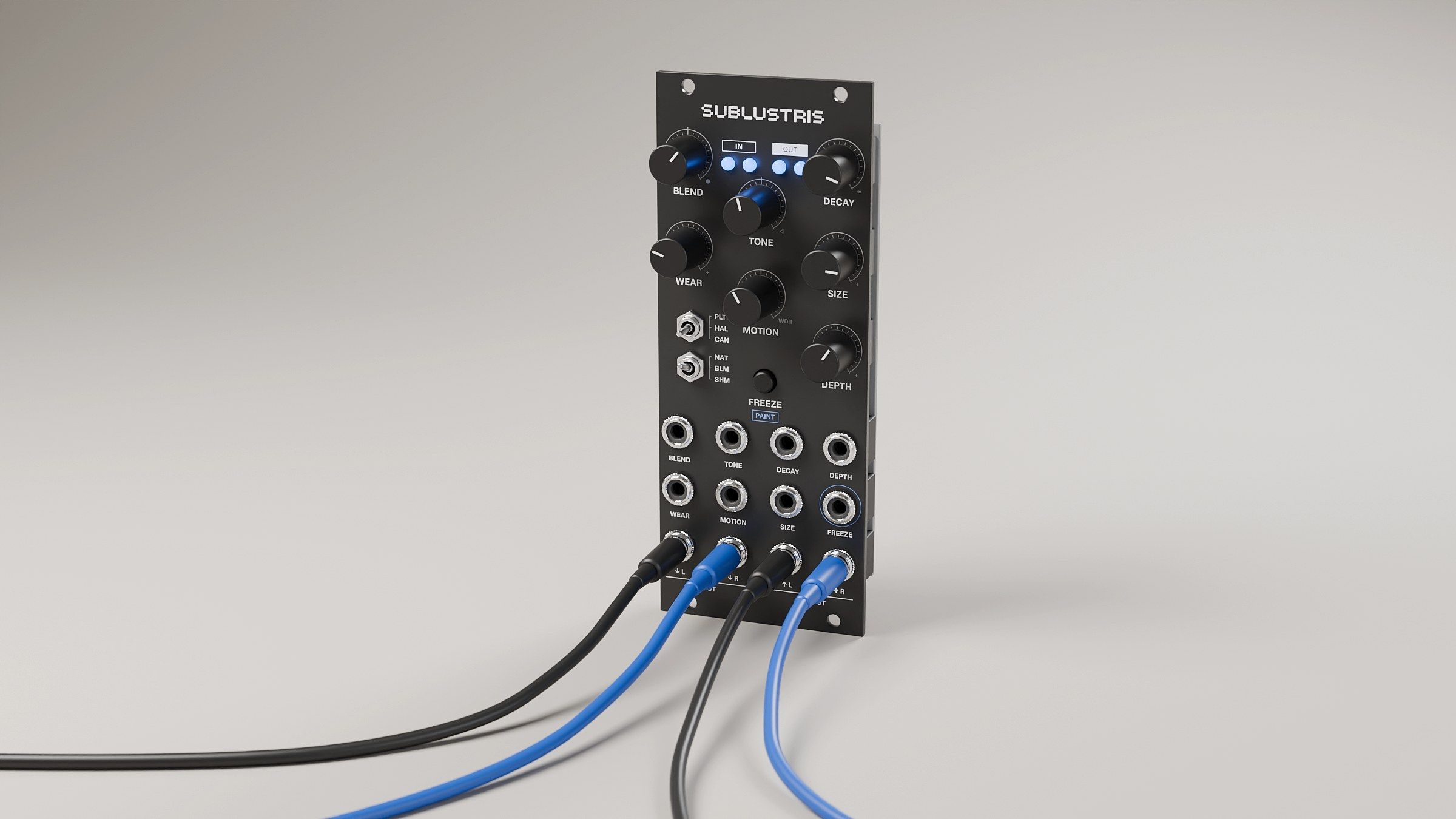
7 CV inputs
One per knob, 0–5 V, added to the knob’s position. Plus a gate for FREEZE.
Two ways to play
On the module
Firmware for the Noise Engineering Versio
Sublustris replaces the module’s firmware completely, and it’s just as easy to go back. You install it with Noise Engineering’s own Firmware Swap web app, and the same app puts any Noise Engineering firmware back on. Sublustris doesn’t change anything else on the module.
The same sound engine runs as an Audio Unit and VST3 plugin for macOS, laid out like the module’s panel. MIDI notes play the freeze, so a clip can freeze and paint in time. You don’t need a Versio to use it.
Sublustris has a sibling, Resilio Versio: a dub spring reverb and tape echo for the same module. Resilio is for throwing hits into springs. Sublustris is for long, deep spaces.